
Amid demands for snapping trade ties with China for its transgressions on the border, former Niti Aayog vice chairman Arvind Panagariya has opined that cutting trade with Beijing at this juncture would amount to sacrificing India's potential economic growth. Instead, Panagariya suggested that India should try to enter into free trade agreements (FTA) with countries such as the UK and the European Union to expand its trade. "Engaging China in a trade war at this juncture will mean sacrificing a considerable part of our potential growth... purely on economic grounds, it will be unwise to take any action in response to it (transgressions on the border)," the eminent economist told PTI.

Former Niti Aayog Vice Chairman Arvind Panagariya has opined that cutting trade with Beijing at this juncture would amount to sacrificing India's potential economic growth.

Credit rating agencies have been raising red flag over high debt to GDP ratio of India.

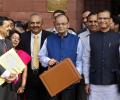
The FRBM report, to be submitted on Tuesday, is likely to have 'excuse clauses', absolving the government of meeting its fiscal commitments under certain conditions such as war or conflict, global economic meltdowns or natural disasters.
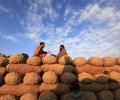
Attributing the growth to an upswing in consumption and investment, the World Bank has said India will continue to be the fastest growing major economy in the world.

Sri Lankans queued up to apply for fresh passports outside the department of immigration and emigration office in Colombo.
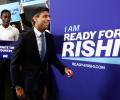
In an accompanying vision statement, the former finance minister highlighted his track record of serving in the Cabinet, helping to steer the economy through the toughest of times with the COVID pandemic.

The Budget has to provide for capex on roads, railways, defence and other infrastructure sectors.
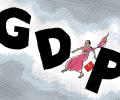
India's Gross Domestic Product (GDP) is expected to expand by 9.2 per cent in the current financial year, according to the Economic Survey 2021-22 tabled in the parliament on Monday. "Advance estimates suggest that the Indian economy is expected to witness real GDP expansion of 9.2 per cent in 2021-22 after contracting in 2020-21. "This implies that overall economic activity has recovered past the pre-pandemic levels," Economic Survey noted. Almost all indicators show that the economic impact of the "second wave" in Q1 was much smaller than that experienced during the full lockdown phase in 2020-21 even though the health impact was more severe, it said.

'The robust tax collections give the finance minister a fair amount of headroom for an expansionary fiscal policy.'

The finance ministry on Wednesday said the government will borrow Rs 4.34 lakh crore in the second half of the current fiscal to meet its expenditure requirement amid COVID-19 crisis afflicting the country's economy.
A parliamentary committee has pulled up the finance ministry for not adhering to Fiscal Responsibility and Budget Management Act in cutting revenue deficit by 0.5 per cent of GDP for 2005-06 saying there should not be deviations every now and then.

It would be interesting to see what the government proposes to investors.

For fiscal year FY23, the 2022 Union Budget had targeted a capex outlay of Rs 7.5 trillion, which is 35.4 per cent higher than the FY22 Budget Estimate of Rs 5.54 trillion.
States also demanded that Budget for 2015-16 should make adequate provisions for central sales tax compensation for early roll out of Goods and Services Tax, a Constitutional Amendment Bill for which was tabled in the Lok Sabha last week.

IThe fiscal deficit target for 2020-2021 was originally set at 3.5 per cent of GDP. But the government's revenues have collapsed and its expenditure burden will only increase over the Budget estimates.' With the government having already planned for an additional borrowing of over Rs 4 trillion, the fiscal deficit for the current year would be much higher than the Budget estimate, notes A K Bhattacharya.

Need of the hour is to spend to grow more, the study said.
'But can it afford to present a scenario within the existing legal framework of fiscal consolidation?', asks A K Bhattacharya.
Vijay Kelkar, advisor to the finance minister, has been entrusted with the new task of preparing quarterly review of the economy as mandated under the Fiscal Responsibility and Budget Management Act.

Just 14 companies raised Rs 35,456 crore through main-board primary share sales in the first half of the fiscal, down 32 per cent from the year-ago period when 25 issues had mopped up Rs 51,979 crore. But according to Prime Database, the IPO pipeline is strong with 71 issues worth Rs 1,05,000 crore having Sebi approvals and another 43 worth about Rs 70,000 crore are awaiting approval. Of these 114 planned issues, 10 are new-age tech companies, which are looking to raise roughly Rs 35,000 crore.

Driven by strong demand, the overall passenger vehicle dispatches crossed 3.35 lakh units in February as automakers, including Maruti Suzuki India, Hyundai, Tata Motors and Mahindra & Mahindra, reported robust sales during the month. The dispatches of more than 3.35 lakh units last month marked an 11 per cent over February 2022. It was also the highest ever overall wholesales in the month of February. The country's largest carmaker Maruti Suzuki India on Wednesday said its domestic wholesales rose 11 per cent to 155,114 units in February as compared with 140,035 units in the same month last year.

The rupee is likely to strengthen to 60-61 level by this fiscal-end on expectations of improvement in current account deficit (CAD) and higher inflows from overseas investors.

This is not an election Budget in the sense that I might target the voter in the coming elections. But if you look beyond this round of state elections, and tilt the periscope to graze at the more distant horizon, see how the Narendra Modi government wishes things looking by the summer of 2024, observes Shekhar Gupta.
The Democratic presidential candidate and his running mate John Edwards have pledged to provide fiscal responsibility in the US government.

Addressing a public meeting after unveiling a 125 ft-tall statue of B R Ambedkar here, KCR said the BRS party was getting a tremendous response from Maharashtra and was expecting a similar reaction from West Bengal, Bihar, and Uttar Pradesh.

Fitch Ratings on Thursday said the resurgence of COVID-19 infections may delay India's economic recovery, but won't derail it, as it kept the sovereign rating unchanged at 'BBB-' with a negative outlook. It projected a 12.8 per cent recovery in GDP in the fiscal year ending March 2022 (FY22), moderating to 5.8 per cent in FY23, from an estimated contraction of 7.5 per cent in 2020-21. Fitch had in June last year revised outlook for India to 'negative' from 'stable' on grounds that the coronavirus pandemic had significantly weakened the country's growth outlook and exposed the challenges associated with a high public debt burden.

Pakistan-India bilateral relations remained frozen for the fourth year over the vexed Kashmir issue but analysts hope the strained ties could be repaired if Nawaz Sharif becomes the prime minister for a record fourth time in the general elections in February in the absence of his main challenger Imran Khan who is in jail in multiple cases.

It would also be the last policy of Rajan

Ahead of the Budget, the government has achieved almost half the divestment target of Rs 65,000 crore. FY23 divestment receipts are unlikely to be anywhere close to the budgeted target.
This move will enable it to incur higher-than-mandated borrowing, and possibly spending, till the 2024 Lok Sabha election cycle.

The government's Rs 20.97 lakh crore COVID-19 package lacks in addressing the immediate concerns of the economy as the actual fiscal impact of the additional stimulus is only about 1 per cent of the GDP as opposed to the claim of 10 per cent, Fitch Solutions said on Tuesday. Prime Minister Narendra Modi on May 12 announced a stimulus package of Rs 20 lakh crore, or nearly 10 per cent of GDP, to deal with the economic fallout of COVID-19. The contents of the package were broad-based and announced in five tranches.
Unveiling far reaching fiscal reforms to improve tax mop up and wipe out revenue deficit by 2009, the Kelkar panel on Friday proposed a single countrywide goods and services tax, removal of tax exemptions and raising income tax slab to Rs 100,000.
